Eleven Days Inside Other People’s Lives

Updated: Jan 13
What a College of the Desert World Film Course at PSIFF Taught Me About Cinema
For eleven days, I lived inside other people’s lives.
That sounds dramatic, but it is the most honest way I can describe what happened to me during the Palm Springs International Film Festival, where I participated in a Contemporary World Film course hosted by College of the Desert professor Michael Gladych. It was not “go see some films.” It was a deliberately designed immersion.

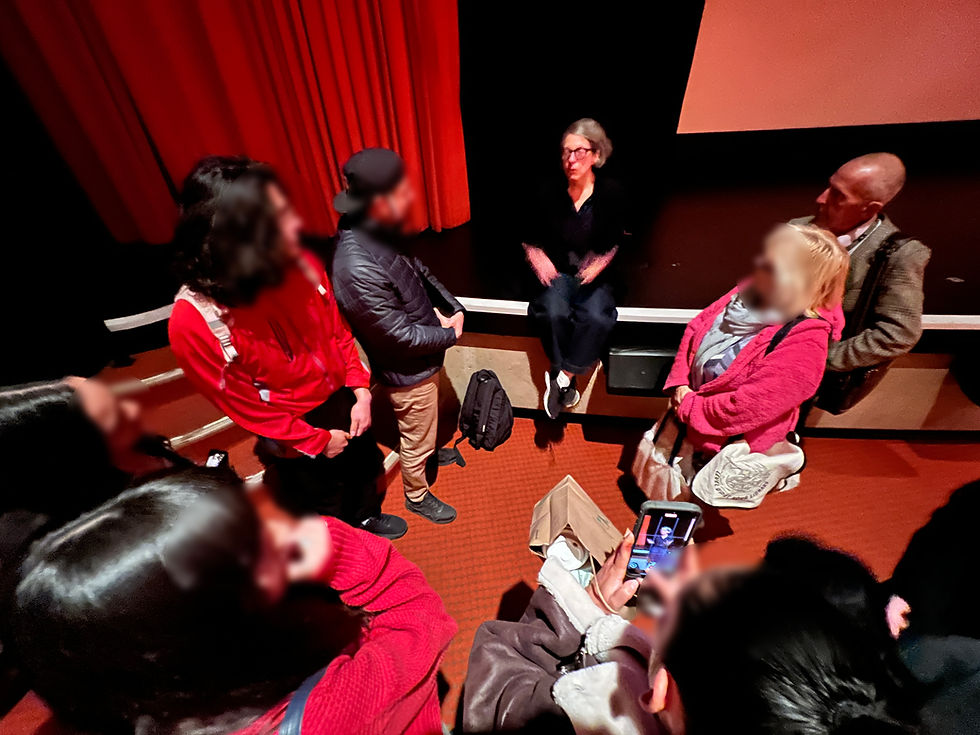
We met one hour before each screening to discuss context and craft. Then we watched the film together. Then we met for an hour afterward to evaluate what we saw. This rhythm repeated again and again until the festival experience stopped feeling like a series of screenings and started feeling like a sustained education in how cinema actually works on the mind, the heart, and the conscience.

COD has built real infrastructure for film education, from its Film Production A.S. curriculum and certificates to courses like Film Production Design, which is explicitly hands-on and focused on high-production-value storytelling. And what struck me during this festival class is that the viewing side of film education is just as crucial as production. The course itself, listed as FILM 021 World Film, is offered in conjunction with PSIFF and requires students to be available across days and evenings during the festival window. That structure is not an accessory. It is the point.
Over those eleven days, I watched COD students become sharper, more articulate, more empathetic, and frankly more dangerous in the best way. They started to speak about shot size, blocking, rhythm, symbolism, editing choices, and production constraints with growing confidence. They were not just reacting. They were analyzing. And they did it as a community.

The films we screened were all brand-new releases and part of the 2026 international feature awards conversation for the Oscars. The lineup felt curated with intention: Taiwan, Argentina, Israel, Belgium, Palestine, Norway, Iran, Brazil, Iraq, Switzerland, North Macedonia, Ukraine. Different languages, different moral landscapes, different forms of suffering and resilience, and yet the same basic question underneath: what does it mean to be human inside your particular circumstances?
Here is what those eleven days gave me.
Left-Handed Girl (Taiwan)
Written and directed by Shih-Ching Tsou
Left-Handed Girl quietly set the standard for everything that followed. Structurally, the film is a masterclass in delayed revelation. Foreshadowing is placed so delicately that its significance stays hidden until the final act reframes what came before. When the payoff arrives, it does not feel like a twist for shock value. It feels like truth finally snapping into focus.
The fact that the film was shot on an iPhone is almost irrelevant once you are inside it, but it also made me deeply respectful of the filmmaking discipline at work. This is not “good for an iPhone.” It is simply good cinema. Tsou uses composed frames, careful staging, and parallel editing that builds meaning across scenes. Sound design is intentional and emotionally precise. Acting, including from non-actors, feels truthful rather than performed.
What stayed with me most was the production design through authenticity of location. Tsou committed to real spaces and real textures, and that commitment matters. You can feel the difference between a place built to resemble life and a place that has actually been lived in. That authenticity becomes emotional credibility.
The film also gave me a window into Taiwan that I did not realize I needed, especially around the lingering cultural preference for male children. The film does not lecture. It observes. It trusts the audience. By the end, I felt both admiration for the craft and sadness that the social reality it reflects still exists.
Tsou is credited as director and co-writer, with Sean Baker also credited as co-writer and editor, and the film’s iPhone production is explicitly documented.
Belén (Argentina)
Directed by Dolores Fonzi, screenplay co-written by Dolores Fonzi with collaborators
I found Belén gripping from the beginning, in part because of the audacity of its creative setup: Dolores Fonzi directs the film and also performs as the central actor. That combination can be a logistical nightmare. Here, it becomes the film’s heartbeat.
What I took away from the director’s comments is that this kind of work demands deep trust. If you are acting, you cannot fully occupy the director’s “external eye” in the moment. So you build a team you trust implicitly, and you accept that the film is made through collaboration rather than control. That trust shows on screen. The performances feel alive, not overly managed. Scenes unfold with emotional breath.
The story builds tension through accumulation. It becomes more gripping as it goes, and the emotional finale holds you in place because the film has earned your investment. The subject matter, rooted in a legal and moral struggle and based on a nonfiction account, gives the film a feeling of urgency.
For me, this film was a reminder that directing is not only about style. It is about stewardship. Fonzi stewards the viewer through difficult terrain without exploiting it.
The Sea (Israel)
Written and directed by Shai Carmeli-Pollak
When I think of The Sea, I think of symbolism that lives inside behavior.
The film’s emotional power comes from how early details are planted and how patiently the film waits to pay them off. The father-son relationship is built through absence, longing, and the small psychological decisions that children make when they do not feel safe. One of the most haunting elements is the boy’s fixation on the image of his mother. That image becomes a moral compass and an emotional tether.
There is also a behavioral pattern that stuck with me: when the boy is lost, he seeks women with children for help and avoids men. The film never explains this with dialogue. It does not need to. It trusts the viewer to understand what experience has taught the child. That trust made the story more powerful.
This film had the kind of narrative satisfaction that comes from coherence, not from surprise. It felt carefully authored, and it is, since Carmeli-Pollak is both writer and director.
Wicked: For Good
Written by Winnie Holzman
This screening felt like a piece of candy in the middle of heavier work, but it was not empty sugar. We had the chance to hear Winnie Holzman speak about adapting the Broadway phenomenon for the screen. We did not address her directly, and that matters to say accurately, but hearing her perspective still gave the class a rare lens into how large-scale studio storytelling gets shaped.
What I kept thinking about was The Wizard of Oz and how carefully Wicked touches that legacy without stepping on it. There is a real risk in revisiting something that culturally sacred. This film uses homage like seasoning rather than replacement, allowing both the 1939 film and this new entry to stand on their own.
Even with its scale, the film carries political symbolism and thematic statements that reward serious viewing. It was also an important contrast for the class: what does “high production value” look like when it is backed by a Hollywood machine, and how does that compare to the emotional power of the low-budget, deeply human international films around it?
Young Mothers (Belgium)
Directed by Jean-Pierre and Luc Dardenne
Watching Young Mothers was one of the most emotionally difficult experiences of the festival for me, because it forced me into a specific kind of empathy: empathy that does not come from agreement, but from understanding.
I found myself internally screaming at the terrible choices some of these teens were making, even though they were already mothers. A girl picking up the father of her baby from prison. A girl being beaten by her own mother. A girl using drugs. The film does not sanitize how messy and painful these lives are.
But the Dardennes’ style, particularly their long takes, prevents you from distancing yourself. You do not get to escape with a quick cut. You stay in the moment. You watch relationships form and fracture in real time. The performances feel painfully real, and the camera work creates a kind of moral proximity.
I kept thinking about American reality TV portrayals of teen motherhood, especially the way shows like Teen Mom build spectacle from instability. This film, though scripted, felt more authentic than “reality” television. That authenticity comes from craft and restraint, and from refusing to turn these girls into caricatures.
Palestine 36 (Palestine)
Written and directed by Annemarie Jacir
Palestine 36 was an eye-opening film for me, not because I had never heard of the conflict, but because it exposed how incomplete my understanding of its origins had been.
The film documents early conditions and power dynamics that shaped what followed, and it does so with a clarity that forced me to confront what I did not know. Jacir’s authorship matters. When a Palestinian filmmaker frames historical narrative, you feel a shift from “history as distant” to “history as lived consequence.” It did not feel academic. It felt personal.
I did have a strong reaction to certain archival choices. Some historical footage is colorized and upscaled in ways that appear digitally enhanced. For me, that took away from the authenticity and pulled me out of the story. It made me think about the processing rather than the testimony. That is not a small criticism. In a historical documentary, your relationship to truth is sacred.
And yet, even with that critique, the film was deeply impactful. It made me more aware of the layered brutality of colonial power, and it made me more cautious about the stories I assume I already understand.
Sentimental Value (Norway)
Directed by Joachim Trier, written by Joachim Trier and Eskil Vogt
Sentimental Value may have had the strongest script of the festival for me, and it is the kind of film that reminds you that writing is not just plot. Writing is emotional architecture.
The story is built around the residue of family, the emotional cost of abandonment, and the way people inherit wounds they did not choose. Trier is known for films that explore interior life with precision, and here, that sensibility becomes generational. The film is not only about what happened, but about what people refuse to say about what happened.
Craft-wise, I was deeply drawn to the editing, especially near the end when a character finally reads a script she had refused to read earlier in the film. That scene could have been played conventionally, but instead the jump cuts create an emotional translation. The cuts become the character’s mind finally moving, finally letting something in, finally allowing truth to land. It is one of those moments where editing is not invisible. Editing is meaning.
The film’s credited craft team supports that effect: Kasper Tuxen on cinematography and Olivier Bugge Coutté on editing are both noted in the film’s credits and coverage.
What stayed with me afterward was the sense that the film understood how art can be both gift and weapon inside a family. Scripts can be love letters. Scripts can also be control. Sentimental Value does not resolve that tension. It lives inside it.
It Was Just an Accident (Iran)
Written and directed by Jafar Panahi
Watching It Was Just an Accident made me grateful to have grown up in the United States, and I do not say that lightly. This film depicts a world where daily life is shaped by systems of control, fear, and consequence that feel suffocating.
Panahi’s authorship matters because his life and work have been defined by confrontation with censorship and repression. The film’s story centers on former political prisoners confronting the possibility of revenge against someone they believe was involved in their torture. Even describing that premise out loud feels heavy. But what Panahi does is deeper than “revenge thriller.” He turns it into an ethical crucible.
The film asks questions that do not have clean answers. What does justice look like when institutions are corrupt? What does revenge do to a person who has already been broken by the state? If you choose mercy, is it moral clarity, or is it another form of captivity?
The tension in the film is not just narrative. It is existential. And it is delivered through restraint. The film does not shout. It endures. The title itself feels like a brutal understatement, the kind of phrase people use when they have been trained to minimize reality in order to survive.
The Secret Agent (Brazil)
Directed by Kleber Mendonça Filho
I struggled with the first half of The Secret Agent. I felt lost, and it took me out of the story. But by the end, I realized that disorientation may have been part of the design.
Set in 1977 during Brazil’s military dictatorship, the film uses environment as pressure. When the story clicked for me, I could feel the film tightening. The production design is astonishing. Wide shots packed with period-accurate elements, cars, signage, architecture, and textures, made me feel transported to 1977 Brazil in a way that seems incredibly difficult to achieve. It takes real resources and obsessive attention to detail to recreate an era convincingly without the frame betraying you.
Near the end, the running sequence felt symbolic to me, like the body continuing after hope has already begun to fade. It read as both physical escape and existential endpoint.
The President’s Cake (Iraq)
Written and directed by Hasan Hadi
Of all the films we screened, The President’s Cake hit me the hardest. If I had to rank the films emotionally, this one sits at the top.
Set in 1990s Iraq, the premise is deceptively simple: a child is selected to provide a birthday cake for Saddam Hussein, and what should be a school “task” becomes an ultimatum. That is the genius and the cruelty. The state weaponizes childhood. It turns innocence into performance. It turns a cake into fear.
The young lead actress (Baneen Ahmad Nayyef) is exceptional, and the film asks her to carry scenes that are heartbreaking, including moments involving predation that made me physically hurt to watch. The film never sensationalizes those moments, which makes them more devastating. It forces you to understand the kind of danger children navigate when a society is distorted by power and scarcity.
Visually, the cinematography in the marshes is exhilarating, not because it is “pretty,” but because the landscape becomes emotional geography. The marshes can feel like escape, entrapment, beauty, dread, all at once. And then the ending, the final image, took my breath away. It is the kind of image that does not fade. It follows you.
The film’s international recognition is significant: it premiered at Cannes Directors’ Fortnight and became the first Iraqi film to win the Caméra d’Or, also winning the Directors’ Fortnight Audience Award. That is not just trivia. It is proof that a film from a place often flattened by headlines can still reach the world through artistry.

Meeting the filmmakers afterward mattered too. Hearing that their partnership grew out of film school and continued into this debut feature made the film feel like an example of what all film students hope for: long-term collaboration, shared language, and a team that grows together into something powerful.
Late Shift (Switzerland)
Written and directed by Petra Volpe
Late Shift is an epic film about what it is really like to be a nurse in the 21st century. “Epic” here does not mean scale. It means intensity. It means the way the film layers stress until you can barely breathe.
Petra Volpe builds the story like a pressure cooker. The protagonist, a nurse named Floria, begins her shift already understaffed, already stretched thin, and the film becomes a relentless race against time. I have enormous respect for how accurately the film captures compounding pressure. It is never just one crisis. It is interruptions, demands, alarms, emotional labor, the constant triage of attention. The film makes you feel what it is like to be responsible for human lives while having fewer and fewer resources to do right by them.
The film is inspired by a nonfiction book about nursing conditions, and that grounding shows. It does not feel like a writer imagining stress. It feels like testimony shaped into narrative.
Leonie Benesch’s performance is extraordinary. She conveys anxiety physically, in breath and posture and micro-decisions, and she makes competence look heroic without romanticizing it. I found myself cheering for her to keep doing a great job even as I knew, inevitably, a mistake was coming.
That inevitability is one of the film’s most honest elements. Under enough strain, failure becomes math. The brilliance is how the film handles the mistake. It does not punish her. It reveals a system that sets people up to fail and then blames them for failing.

Volpe also took real time to discuss the film with our class, answering questions and educating us about her experience as a filmmaker. That generosity mattered. It connected the art to the human who made it.
The Tale of Silyan (North Macedonia)
Directed by Tamara Kotevska
The cinematography in The Tale of Silyan was so astonishing that I genuinely needed reassurance that what I was seeing was real. The film explicitly notes that no AI was used, and I understood why. Some images feel impossible.
This film comes from Tamara Kotevska, known for Honeyland, and it carries a similar commitment to intimate truth, rural life, and the slow forces that shape people’s survival. The story follows Nikola, a farmer crushed by economic realities and policies that make survival feel like a trap, who forms an unlikely bond with an injured white stork named Silyan after taking work at a landfill. That premise sounds simple. The film makes it mythic without making it fake.
One image I cannot shake is the stork’s neck aligning with the moon. It felt like a miracle, and in a post-AI world, miracles are suspect. That is why the “no AI” statement matters. It is the filmmaker saying: trust your eyes again.
What moved me was the contrast between worlds. The film shifts between farm life, city life, and the dump, and those spaces become moral landscapes. The farm is heritage and identity. The city is departure and disconnection. The landfill is modern consequence, the afterlife of consumption. Even in documentary, this is production design in the deepest sense: the curation of environments to reveal meaning.
The costuming and ritual elements, especially the New Year’s celebration, made me feel connected to the people rather than simply observing them. The film gave me sorrow for a way of life fading not only in North Macedonia but across the world. It made me ask what we lose when we trade agrarian life for modern convenience, and whether we even notice what is disappearing until it is gone.
2000 Meters to Andriivka (Ukraine)
Directed by Mstyslav Chernov
This documentary was stunning, and it shattered me.
Mstyslav Chernov follows a Ukrainian platoon on a mission toward the village of Andriivka, documenting what it costs to move a short distance in a modern war where drones, snipers, artillery, and exhaustion turn every meter into a moral and physical trial. The film is connected to the same team behind 20 Days in Mariupol, and it carries that same insistence on proximity.
What I experienced while watching was a cycle: horror, dread, fear, sadness, then a moment of levity, then back into terror again. That cycle is what made the film feel human. The levity did not undermine the tragedy. It proved the soldiers were still alive inside the nightmare.
The editorial construction is extraordinary. The film uses combat footage and moments of reflection in a way that makes chaos coherent without sanitizing it. PBS FRONTLINE describes the documentary as a collaboration that includes combat bodycam footage and intimate reflection, which matches what I felt in the theater.
I cannot overstate the respect I have for the filmmaking achievement here. War footage is inherently fragmented. To shape it into an emotional journey that preserves humanity takes rare editorial judgment. It is not simply “cutting.” It is moral decision-making: what to show, what to hold on, when to give the audience room to breathe, and when to refuse them that comfort because comfort would be dishonest.
When it ended, I did not feel catharsis. I felt responsibility.
Why This Kind of Film Education Is Essential
At the end of the course, the students took a final exam that asked them to reflect on what they learned, how the films affected them, and how they would rank their top three. Listening to them speak, it was obvious how much they had grown in only eleven days.
They were more sophisticated viewers. Not just louder with opinions, but better with language. They were noticing structure, identifying themes, recognizing craft. They were talking about editing choices, shot sizes, production design authenticity, symbolism, pacing, and performance with increasing confidence. They were practicing the skill that separates a casual watcher from a filmmaker: the ability to explain why something works.
This is why curated, discussion-driven film education matters. It trains students to see cinema as a made thing. A constructed language. A moral act. It shows them that films are not just stories, but decisions: what to include, what to omit, where to place the camera, how to shape time, how to honor truth, how to avoid exploitation.
Watching films alone can build taste. Watching films in a community, with structure, repetition, and deep discussion, builds craft literacy. It builds empathy. It builds discernment.
Professor Gladych’s work mattered because he did not simply assign films. He curated a journey. And in that journey, students learned something essential that every filmmaker must learn sooner or later:
Cinema is not content. Cinema is communion.
And if you ever have the chance to give eleven days of your life to film after film after film, and then talk about each one with people who watched it with you, before and after, take it. It will change how you see. It will change how you critique. It will change what you believe film can do.


Comments